
Development of Cost-Effective Ground-Launched Counter-Air Missile
Overview of the Initiative
The U.S. Air Force is soliciting innovative proposals for the development of its next counter-air missile, aiming for a target production cost of $500,000 per unit. This endeavor falls under the Counter-Air Missile Program (CAMP), which seeks to establish a framework for future low-cost air-to-air missile capabilities.
Missiles: Bridging Technology Gaps
In a recent solicitation on SAM.gov dated November 7, the Air Force expressed its objective to create a ground-launched missile that integrates open-system architecture and modular design principles. The focus is on affordability and high production capacity, with the inaugural phase dedicated to the prototyping of ground-launched platforms over a two-year timeline.
- Phase One: Development of and demonstration for a ground-launched prototype.
- Phase Two: Transition into the formal program of record.
- Future Phases: Evolution towards an air-to-air missile variant.
Industry feedback is required by December 2, enabling collaboration between the Air Force and defense contractors for the realization of this project.
Cost Comparisons and Existing Arsenal
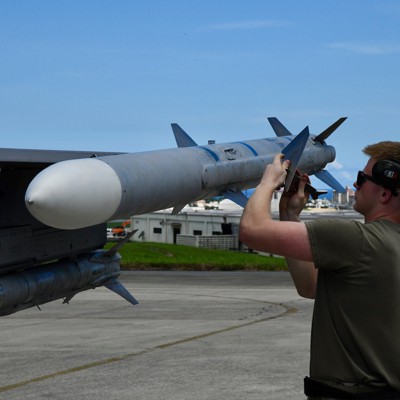
The proposed missile’s anticipated cost is substantially lower than the current AIM-120D Advanced Medium-Range Air-to-Air Missile, which retails for approximately $1 million. The new missile’s price point also aligns closely with the AIM-9X Sidewinder at around $472,000. However, it is significantly more expensive than the Airborne Laser-Guided Training Maneuvering Weapon System (APKWS II), whose components cost approximately $15,000 to $20,000.
Existing Alternatives
- AIM-120D: $1 million
- AIM-9X Sidewinder: $472,000
- APKWS II: $15,000 – $20,000 for high-cost components
- Tomahawk Cruise Missiles: Approximately $2.2 million
Strategic Context and Funding
The impetus for this missile initiative follows the recent passage of a reconciliation bill that allocated $250 million specifically for the development of low-cost counter-air capabilities within the Air Force. This announcement coincides with Defense Secretary Pete Hegseth’s appeal for enhanced investment and accelerated timelines in defense acquisitions.
The solicitation emphasizes the Department of Defense’s strategic priorities, which include:
- Innovating to gain a competitive edge for warfighters
- Accelerating production timelines
- Fostering scalable deliveries
Intersection with Current Programs
The requested counter-air missile will contribute to the Air Force’s new class of munitions termed the “Enterprise Test Vehicle,” which is being pursued in collaboration with the Defense Innovation Unit (DIU). Companies such as Anduril and Zone 5 Technologies have advanced to critical testing phases under this program, indicating a strong push toward integrating next-generation technologies with existing systems.
Current discussions around the missile’s operational deployment remain ambiguous, particularly regarding its potential utility alongside established air-to-air munitions and counter-drone technologies already in the Air Force’s inventory.
Conclusion
As the Air Force embarks on this innovative project, the dual objectives of cost efficiency and technological advancement will be critical for future air combat capabilities. The success of CAMP could reshape the landscape of U.S. air defense, ensuring that the Air Force maintains a robust and adaptable arsenal in a rapidly evolving threat environment.