

India’s Advancement in Hypersonic Missile Technology: The Long-Range Anti-Ship Missile (LR-AShM)
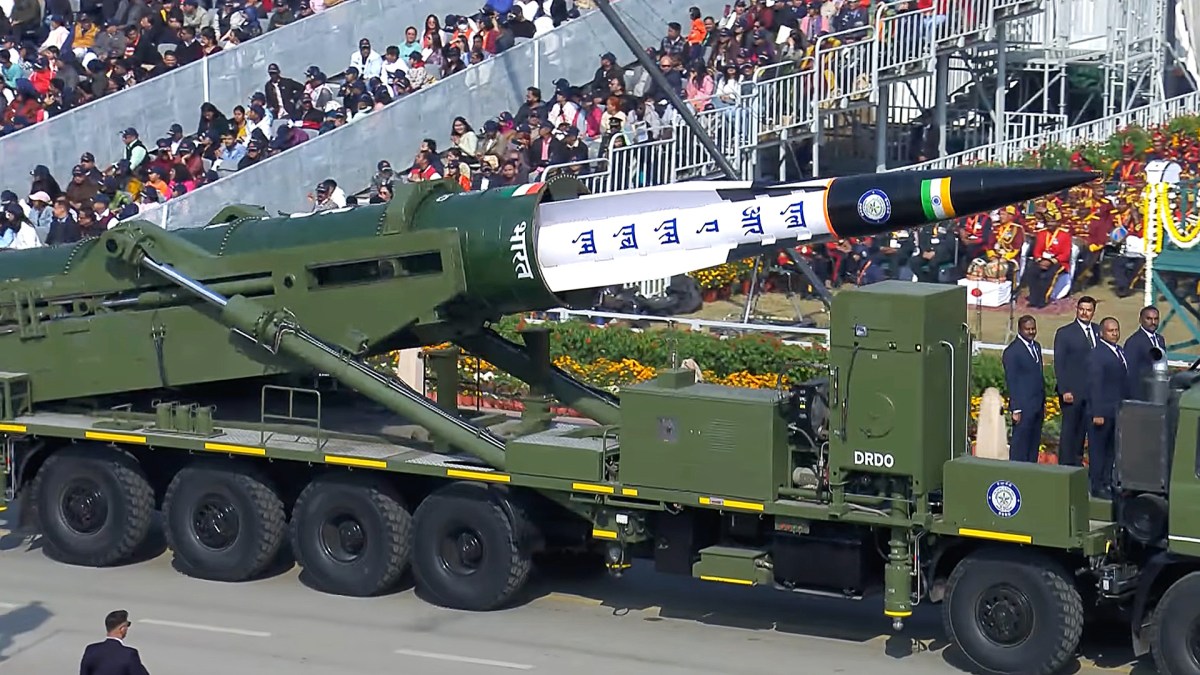
India has recently showcased what it claims to be its maiden long-range hypersonic missile, the Long-Range Anti-Ship Missile (LR-AShM), during the 77th Republic Day celebration in New Delhi. Developed by the Defense Research and Development Organization (DRDO), this new missile aims to enhance India’s military capability against regional adversaries, particularly Pakistan and China.
Strategic Context
The unveiling of the LR-AShM coincides with increasing military developments in neighboring countries. India’s move to introduce this missile reflects its commitment to maintaining a competitive edge amidst an evolving security landscape in South Asia:
- Countering Regional Rivals: The LR-AShM is designed to keep pace with similar advancements from Pakistan, specifically its SMASH anti-ship ballistic missile, and to address China’s expanding naval capabilities.
- Naval Superiority: This missile is viewed as a crucial element in anti-access and area-denial (A2/AD) strategies, focusing primarily on high-value maritime targets like aircraft carriers.
Technical Specifications and Operational Capabilities
The LR-AShM features a robust design, implemented on a mobile launcher mounted on a 12×12 high-mobility truck chassis. Here are some essential operational aspects:
- Payload and Range: Capable of carrying varied warheads, the missile boasts a range surpassing 1,500 kilometers (approximately 930 miles).
- Dimensions: Considered an imposing weapon, the LR-AShM is reported to be around 14 meters (46 feet) in length, with a diameter of approximately 1.4 meters (4.6 feet), and a launch weight below 20,000 kilograms (44,000 pounds).
Propulsion and Guidance
The missile employs a two-stage solid propulsion system, purportedly achieving speeds of up to Mach 10. This exceptional velocity is attributed to its ability to perform low-level runs, allowing it to evade detection by ground and ship-based radars effectively.
- Guidance System: While specific details remain sparse, the Indian Ministry of Defense has indicated the use of “high accuracy sensor packages” for targeting both stationary and moving objects. Speculations about an active radar seeker in the terminal phase suggest a technological lineage that could draw influence from the BrahMos supersonic missile.
Missile Classification: Quasi-Ballistic vs. Hypersonic Glide Vehicle (HGV)
There is ongoing debate about the classification of the LR-AShM:
- HGV Characteristics: Traditionally, hypersonic glide vehicles (HGVs) are propelled to high speeds by a rocket motor and glide along less predictable trajectories. Such designs offer significant maneuverability, complicating interception efforts.
- Quasi-Ballistic Features: Observations indicate that the LR-AShM may exhibit qualities of a quasi-ballistic missile. Its trajectory entails unpredictable maneuvers, potentially enabling it to outperform conventional defense systems in terms of target engagement.
Implications for Regional Security
The LR-AShM renders enhanced strike capabilities against naval assets, reinforcing India’s deterrent posture in the Indian Ocean. The Indian Navy could utilize it as part of an A2/AD framework, aiming to:
- Target significant naval vessels, including carriers and amphibs.
- Launch precision strikes against land-based targets if necessary.
Eliminating Time Sensitivity
A hypersonic missile like the LR-AShM fundamentally alters combat dynamics. Its increased speed allows for a rapid strike capability, which is immensely effective against time-sensitive targets.
Future Developments and Tactical Adaptations
Post-unveiling, India’s military is reportedly considering adaptations of the LR-AShM to arm surface vessels, aiming to align its tactical options with those of China and Russia, which already deploy ship-launched hypersonic missiles.
Comparison to Existing Systems
While the BrahMos remains a formidable anti-ship missile with its supersonic capabilities, the LR-AShM augments India’s strategic arsenal by providing:
- A greater range and speed over existing systems.
- A diversified set of launch options, which can be crucial in a multi-target engagement scenario.
The Broader Missile Landscape
In terms of regional advancements, India’s hypersonic capabilities place it among nations like China and Russia that lead in missile technology. Pakistan’s pursuit of its anti-ship ballistic missile, the SMASH, emphasizes the accelerating arms race in the region.
Conclusion
India’s pursuit of advanced military capabilities, marked by the unveiling of the LR-AShM, underscores its strategic intention to bolster its naval power and deterrent capabilities. As tensions persist in South Asia, the development not only reflects India’s defense modernization but reinforces its ambition to emerge as a dominant maritime power.
Contact Information: For further insights, please reach out to the author at thomas@thewarzone.com.