Redefining U.S. Army Priorities: The Shift from European Defense to Drone-Centric Operations
Since the end of World War II, the U.S. Army has been primarily structured to defend Europe. Despite a historical pivot towards counterinsurgency operations in Southeast Asia and the Middle East, the backbone of the Army has consistently retained its heavy mechanized brigades.
Evolving Strategic Landscape
Recent U.S. administrations have signaled a shift in strategic focus away from Europe. The Obama administration emphasized a reorientation towards Asia, and the current Trump administration prioritizes:
- Homeland defense
- Western Hemisphere security
- Strategic interests in the Pacific
This raises an essential question: How can a military tailored for European defense adapt in an era where Europe is not the primary focus?
The Case for Drone Incorporation
An emerging perspective suggests reconfiguring military assets through drone technology. Benjamin Jensen, Director of the Futures Lab at the Center for Strategic and International Studies (CSIS), advocates for an expeditionary drone force as a cost-efficient alternative to traditional large garrisons stationed overseas.
Proposal for Mixed Drone Units
Jensen posits that:
- Large garrison-based forces with infantry and armor should transition to mixed drone units capable of rapid deployment.
- These units could bolster partner nations’ combat capabilities more effectively.
He visualizes a system wherein NATO European members supply conventional combat equipment, such as tanks, while U.S. drone units contribute with strike, reconnaissance, and electronic warfare capabilities.
Operational Flexibility
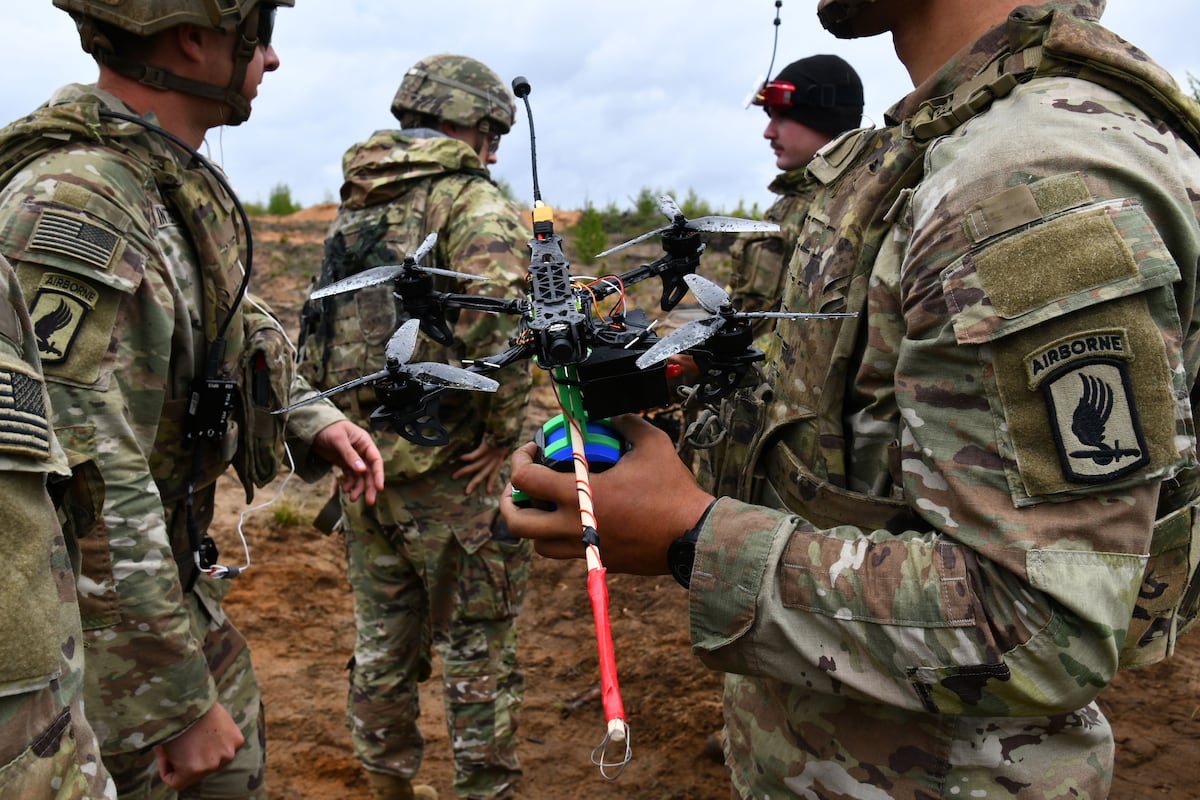
Instead of maintaining a conventional battalion of 1,000 personnel, a rotation of 250 soldiers could manage an array of 500 first-person view (FPV) drones and octocopters. This model allows for:
- Quick deployment and retraction of forces.
- Joint operations alongside European partners.
Economic Substitution
The concept of “substitution,” inspired by economic principles, is a key element in Jensen’s argument. Just as consumers opt for cost-effective alternatives without compromising quality, drones can fulfill certain operational roles traditionally held by ground troops, enhancing flexibility and reducing costs.
Enhanced Capabilities
Jensen suggests that substituting conventional platforms with advanced drone formations offers U.S. strategic interests greater adaptability in Europe. He highlights several key functionalities of drones:
- Versatility in Payloads: Drones should be engineered for quick reconfiguration across varied missions, including intelligence gathering, electronic warfare, and direct engagement operations.
- Force Multiplication: A drone brigade could execute a wide range of tasks, from extensive area surveillance to tactical strike missions against potential adversaries.
Army Modernization Initiatives
The Army is partially embracing this transition through its Army Transformation Initiative, emphasizing rapid development and deployment of smaller drones. However, Jensen critiques initiatives aimed at phasing out medium-altitude, long-endurance (MALE) drones, such as the MQ-1C Gray Eagle, arguing that they provide capabilities beyond those of smaller drones.
Reserve Forces and Cost Efficiency
Jensen emphasizes an often-overlooked aspect of drone integration: the potential for establishing new unmanned aerial vehicle units within the Army Reserve and National Guard. Existing aviation units, some facing cuts, could be repurposed as drone operators, thereby minimizing operational costs and ensuring quick mobilization when necessary.
NATO and Future Deterrence Strategies
The reception of a drone-centric operational model by NATO allies remains a crucial consideration. Jensen believes that even a partial capability, such as drone forces, would be preferable to the current absence of U.S. military presence.
Implications for Deterrence
Adopting drone-centric expeditionary forces could redefine deterrence strategies in Europe. Instead of maintaining a constant armored presence, mobile drone brigades could be deployed rapidly to Eastern Europe to convey U.S. commitment to NATO during crises. In the Pacific, these agile units would be especially beneficial given the vast distances to cover.
Conclusion: Redefining Military Posture
The introduction of drone formations offers a sophisticated approach to contemporary military challenges, moving away from Cold War-era deterrence. According to Jensen, the capacity to deploy adaptable, technology-driven units provides strategic advantages and operational flexibility vital for addressing modern geopolitical threats. The transformation of U.S. military posture not only meets evolving strategic imperatives but also ensures sustained support to allied nations in volatile environments.